30 Oct 2026
Al-Kahf Mosque Architecture: When the Roof Becomes a Source of Ablution Water
Al-Kahf Mosque Architecture: When the Roof Becomes a Source of Ablution Water
Share:


Mosque architecture does not always have to be expressed through monumental structures. In certain conditions, design decisions are driven by essential needs such as site accessibility, construction methods, climate, and water availability for daily activities.
This approach can be seen at Al-Kahf Mosque in Poco Dedeng, Lembor, West Manggarai, East Nusa Tenggara. Designed by Ar. Yanuar PF, ST, MBA, IAI, in collaboration with Aaksen Responsible Architecture, the mosque measures 9 × 9 meters, covering approximately 81 m². Limited access and infrastructure prompted the adoption of prefabricated modular construction, lightweight materials, and rainwater harvesting.
Responding to rainfall, site conditions, and building systems is also an important aspect of tropical architecture in Indonesia.
How Does Al-Kahf Mosque Architecture Respond to Site Conditions?
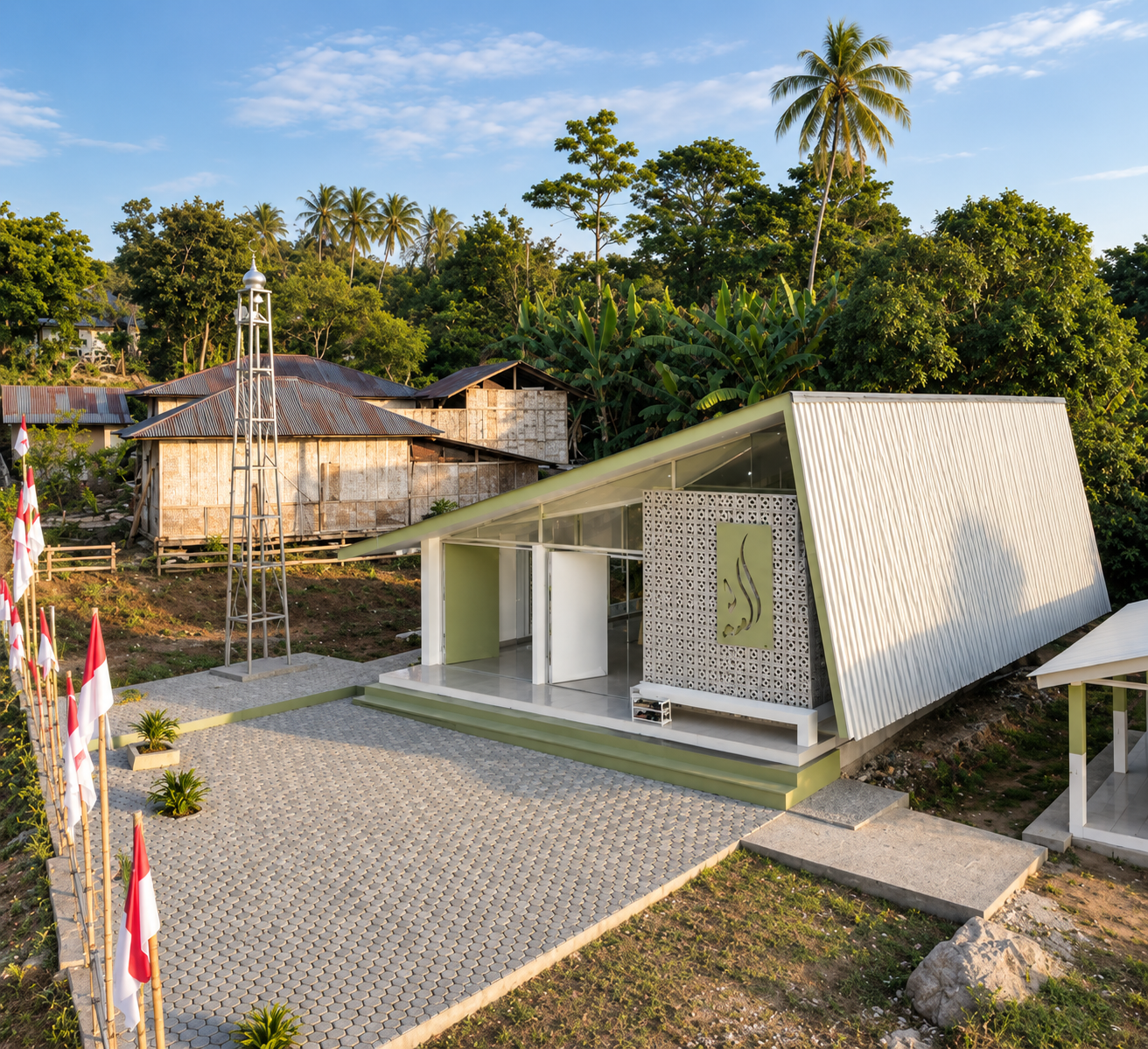
Al-Kahf Mosque is designed to support a rainwater harvesting system.
Remote Locations Require a Different Construction Approach
Limited access to the site means that conventional construction methods may not always be the most practical option. Material transportation, the amount of on-site work, and assembly processes must be considered from the initial design stages.
For this reason, the modern mosque design of Al-Kahf adopts simple geometry to make building components easier to manufacture, transport, and assemble on-site.
The 9 × 9 Meter Module Simplifies Construction
Al-Kahf Mosque introduces an innovative prefabricated modular approach, allowing construction to be completed quickly and efficiently using lightweight components in an area with limited infrastructure access.
The use of BlueScope ZINCALUME® coated steel in the roofing system plays an important role in supporting building performance under humid tropical conditions and heavy rainfall.
The material was selected for its high corrosion resistance, lightweight characteristics that facilitate transportation, and ability to support an effective rainwater harvesting system through carefully designed roof slopes.
This construction system allows the building to be assembled in approximately three weeks, with participation from the local community.
For other approaches to public facilities and buildings with diverse site requirements, explore the COLORBOND® Infrastructure Inspirations collection.
Modular Mosque Design Simplifies the Construction Process
The concept of modular mosque design allows building components to be planned and prepared before on-site installation.
For contractors, this approach requires early coordination of component modules, delivery sequences, connections, and structural erection.
Prefabrication at Al-Kahf Mosque does not mean that the construction process is entirely separated from the local community. Instead, its relatively straightforward construction system enables residents to participate directly in the building process.
The Roof Plays a Key Role in Tropical Mosque Architecture
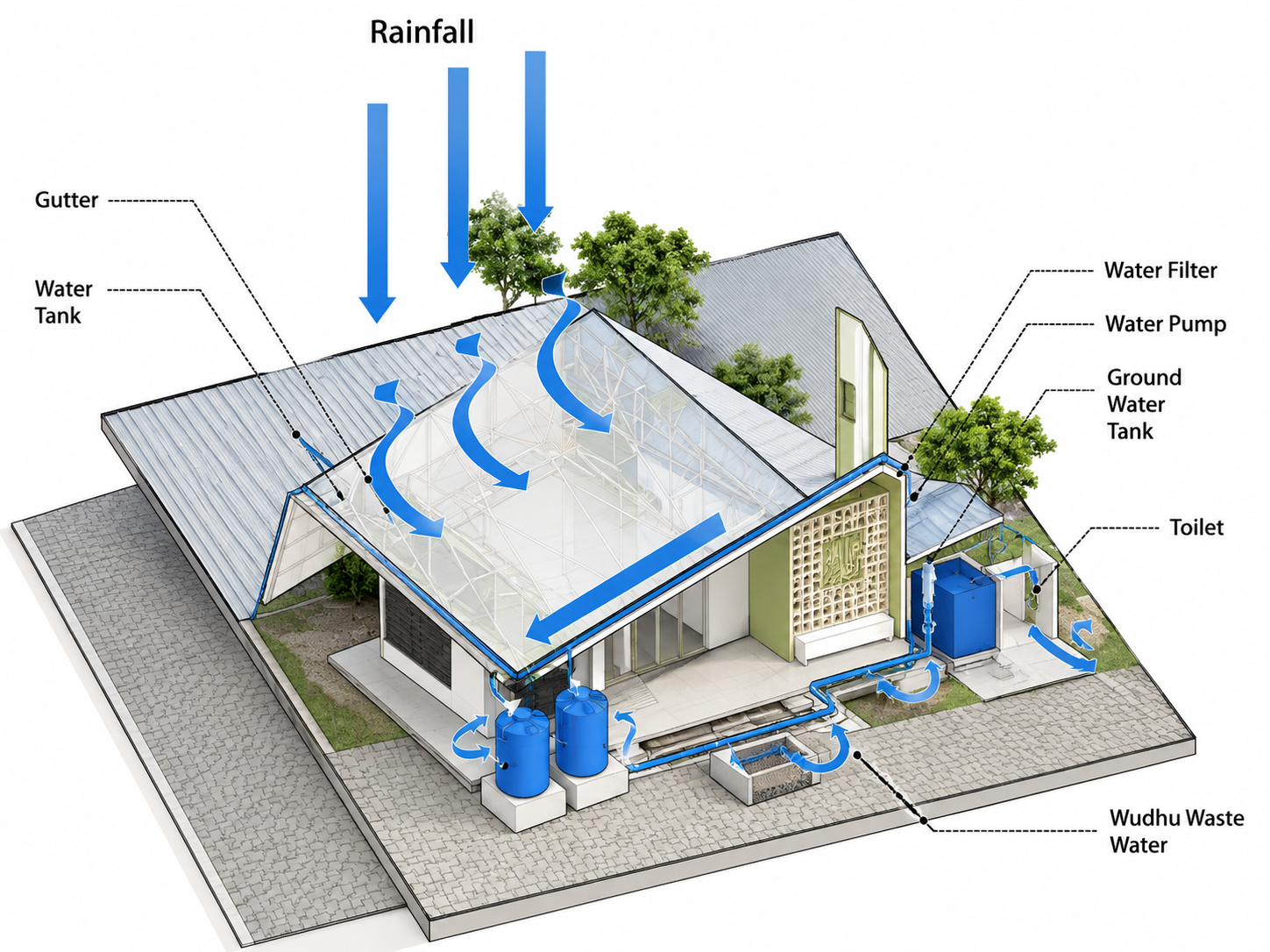
Al-Kahf Mosque features a roof design that collects rainwater for ablution purposes.
One of the most distinctive design decisions in Al-Kahf's tropical mosque architecture is its roofing system. The roof slopes are designed to direct rainwater into a rainwater harvesting system.
The collected water is channeled into storage tanks, filtered, and then used for ablution, or wudhu.
This means the roof functions not only as a protective building element but also as part of the mosque's water infrastructure.
A similar approach that connects architecture with water management can be seen at Desa Binaan Tampelas, a nominee in the Infrastructure category of the Steel Architectural Awards Indonesia 2026.
The project integrates buildings, water, energy, and community needs into a unified system.
Used Ablution Water Is Reused for Landscaping
The water cycle does not end after ablution.
According to the project documentation, used ablution water is filtered again before being reused to irrigate vegetation around the mosque.
The process follows a simple sequence: rainwater is collected from the roof, stored for ablution, and subsequently reused for landscaping after filtration.
Through this approach, the building, utility systems, and surrounding vegetation function as interconnected elements.
ZINCALUME® Supports the Mosque's Modular Roofing System
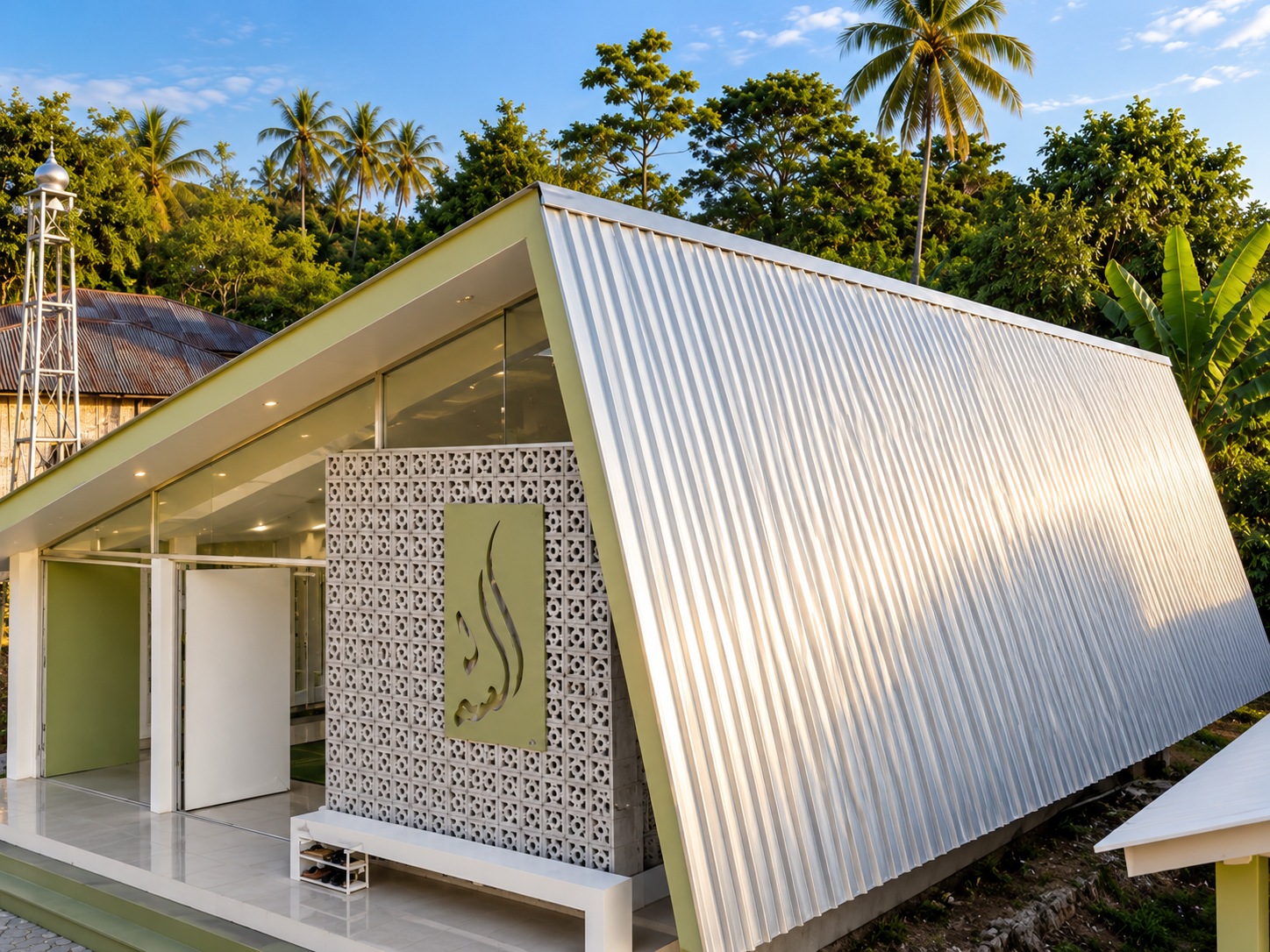
BlueScope metal roofing materials support lightweight and durable construction.
The project uses BlueScope ZINCALUME® roofing materials. These materials form part of the lightweight construction system, designed to simplify transportation to the remote site and installation alongside prefabricated building components.
For public facilities and infrastructure projects, suitable material systems can be explored through the COLORBOND® Infrastructure Products collection.
Using the roof as a rainwater catchment surface requires careful coordination of roof slopes, supporting structures, panel modules, connections, gutters, and water collection points.
Beyond material systems, color selection can also contribute to the building's architectural identity. Available options can be explored through the COLORBOND® Standard Colors collection.
Complete Mosque Architecture with COLORBOND® Steel
Mosque architecture projects such as Al-Kahf Mosque require materials that support roof geometry, modular construction, and water management systems.
In this project, ZINCALUME® is used in the roofing system as part of a lightweight construction approach that facilitates material transportation and installation in an area with limited accessibility.
For the development of mosques and other infrastructure facilities, COLORBOND® Steel can be applied to roofing, walls, façades, and cladding. Its range of profiles and colors provides architects with flexibility when selecting materials to complement the architectural concept and environmental conditions of each project.
COLORBOND® Steel is developed with Thermatech® Solar Reflectance Technology, Clean Technology, AZ150–AZ200 coatings, and a Super Polyester Paint System.
With a global heritage spanning 60 years, COLORBOND® Steel is a globally recognized coated steel brand from BlueScope that continues to evolve in response to present and future building requirements.
COLORBOND® Steel is also supported by a corrosion warranty of up to 35 years and a color warranty of up to 12 years, subject to applicable terms and conditions. These warranties can be among the considerations when selecting materials for infrastructure buildings.
The selection of profiles, colors, fastening systems, roof slopes, connections, gutters, and drainage details must be adapted to the specific conditions of each project.
These considerations can be discussed further by consulting the COLORBOND® Steel team to explore suitable material solutions.
FAQ
What is the function of rainwater harvesting at Al-Kahf Mosque?
Rainwater is collected through the roof surfaces, stored, and filtered to provide water for ablution purposes.
What happens to the used ablution water?
Used ablution water is filtered again and reused to irrigate vegetation surrounding the mosque.
What material is used for the mosque's roof?
The project documentation identifies ZINCALUME® as the roofing material. However, the specific profile, thickness, grade, and coating mass are not provided and are therefore not assumed in this article.
References
1. Steel Architectural Awards Indonesia 2026 finalists featured on the COLORBOND® website:
2. Related articles from the COLORBOND® Steel website: