17 Apr 2026
Hot Outside, But the Roof Stays Cool? Discover Emak’s Home Strategy!
Hot Outside, But the Roof Stays Cool? Discover Emak’s Home Strategy!
Share:


Have you ever stepped into a house that instantly feels cool without the constant hum of air conditioning?
Interestingly, that kind of comfort doesn’t always come from large spaces or plenty of windows. Often, it’s the result of quiet design decisions that work in the background, in places we rarely think about: the roof.
In our climate, the roof acts as the first line of defense. It takes on the most intense exposure to the sun every single day. A poorly designed roof will absorb heat, store it, and slowly release it into the interior even well into the night. That’s why many homes still feel uncomfortably warm long after the sun has set.
In Indonesia, the roof truly sits on the front line. It faces constant solar exposure, absorbs heat throughout the day, and gradually releases it into the living space. It’s no surprise that many homes feel like they trap heat even after sunset.
However, Rumah Emak, one of the projects featured in the Indonesia Steel Architecture Award 2024, offers a different approach. Instead of fighting the climate, the house works with it. And it all begins from above.
A Roof That Does More Than Just Provide Shelter
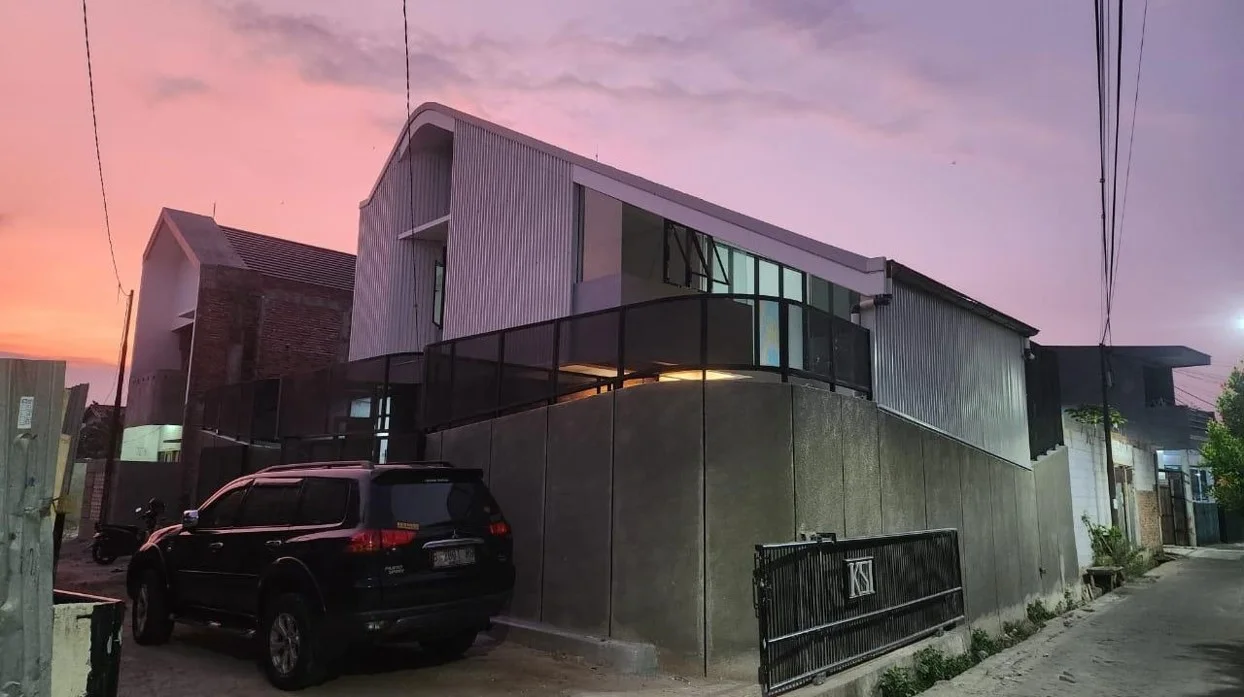
In many tropical homes, the roof is often treated as a purely protective element. However, it is precisely at this level where the majority of heat first interacts with the building.
Rumah Emak adopts a different perspective by positioning the roof as an active layer not merely as a covering, but as a key component in regulating indoor temperature.
Rather than allowing heat to accumulate and be retained within the structure, the selected roofing material is designed to reflect solar radiation back into the atmosphere.
While this approach may appear simple in principle, its impact on spatial comfort is significant. Indoor environments no longer feel excessively hot during the day, reducing the reliance on mechanical cooling systems to maintain comfort.
As a result, the interior climate becomes more stable. Spaces do not heat up rapidly, nor do they retain excessive heat over time.
Reflecting, Not Absorbing
Materials such as COLORBOND® steel, enhanced with Thermatech® technology, are designed to follow this principle reducing heat before it has the chance to become an issue.
Instead of allowing heat to transfer into the building structure, the roof surface actively reflects solar radiation back outward.
The impact goes beyond measurable temperature reduction. It influences how the space feels lighter, more comfortable, and less oppressive.
In the context of tropical architecture, this is not merely a technical feature, but an integral part of a well-considered design strategy.
When Materials Become Part of Comfort
There is a common tendency in modern architecture to evaluate materials primarily from an aesthetic perspective how they look and how they shape the façade.
However, in projects such as Rumah Emak, materials perform beyond appearance. They contribute directly to the overall comfort and performance of the space.
In addition to Thermatech®, other often-overlooked approaches are applied, such as Clean Technology a system designed to help surfaces remain cleaner by minimizing stains caused by the combination of dust, heat, and tropical humidity.
In climates like Indonesia, where rain and pollution coexist, this goes beyond visual appeal. It plays a crucial role in long-term maintenance and durability.
Combined with the Super Polyester Paint System, the material not only withstands weather exposure but also maintains color stability over time.
In other words, the material does not merely endure it continues to perform and remain relevant over the long term.
Durability as Part of Design
_quality(85)%20(3).webp)
In architecture, the true challenge is not budget it is time.
A building only truly begins its life after handover. From that moment on, it must continuously withstand intense sunlight and heavy rainfall. This is why material selection is not merely about present-day aesthetics, but about how it will perform and age over the years ahead.
Choosing materials with up to 35 years of corrosion resistance and up to 12 years of color durability* is an investment in long-term reliability and peace of mind. A well-designed building should not burden its occupants with constant maintenance, but instead remain resilient and refined over time.
*Terms and conditions apply.
Tropical Living, A New Perspective on Comfort
The Rumah Emak project serves as an important reminder that comfort does not always need to be engineered through complex additional systems. More often, it is the result of thoughtful design decisions made from the very beginning.
It is about selecting materials that reflect heat rather than absorb it. It is about understanding how the roof functions as protection against the intensity of the tropical sun. Ultimately, it reminds us that the simplest elements can often create the most meaningful impact on how a space is experienced.
Amid the growing complexity of modern architecture, this kind of calm and intentional approach feels increasingly relevant effective without being excessive.
In the end, a well-designed home is not only one that looks good in photographs, but one that feels naturally comfortable without force. The answer lies not in what we add at the end, but in the choices we make from the very beginning.
Including what we place right above our heads.
FAQ
1. What is Solar Reflectance Index (SRI) in roofing?
Solar Reflectance Index (SRI) is a value that indicates a roof surface’s ability to reflect solar heat and release absorbed heat. The higher the SRI value, the less heat is absorbed into the building, resulting in a more comfortable indoor environment.
2. Why are high-SRI steel roofs suitable for homes in Indonesia?
Indonesia has a tropical climate with high solar exposure, humidity, and rainfall. High-SRI steel roofs help reflect more solar heat, supporting better thermal comfort and reducing the need for mechanical cooling.
3. Do steel roofs make a house feel hotter?
Not necessarily. Perceived heat depends on several factors, including material type, color, coating technology, installation details, ventilation, and insulation. Modern steel roofing with heat-reflective technology and proper installation can help maintain a more comfortable indoor temperature.
4. What are the advantages of modern steel roofing compared to conventional materials?
Modern steel roofing typically offers advantages such as lighter weight, structural strength, design flexibility, weather resistance, and relatively low maintenance. Certain products also include features such as heat reflectivity, color stability, and resistance to tropical staining.
5. How can a home be kept cooler aside from choosing the right roof?
In addition to selecting high-SRI roofing, tropical homes should incorporate cross ventilation, controlled natural lighting, proper insulation, well-designed openings, and transitional spaces such as terraces or semi-outdoor areas.
6. Does roof color affect building heat?
Yes. Roof color influences how much solar heat is absorbed. Lighter colors generally reflect more solar radiation than darker ones. However, overall performance also depends on coating technology and material specifications.
7. Are steel roofs suitable for modern home design?
Yes. Steel roofing is widely used in modern homes due to its clean appearance, strong lines, and flexibility in design. It supports architectural needs that prioritize efficiency, durability, and contemporary aesthetics.
8. What should be considered when choosing a steel roof for a home?
Key factors include SRI value, corrosion resistance, coating technology, roof profile system, installation quality, compatibility with local climate conditions, and overall design requirements.
Refrence:
https://steelarchitecturalaward.com/en/project-honorees/award-2024/