21 Apr 2026
Jakarta International Stadium: Icon of Modern Stadium Design
Share:
Capturing the Essence Behind the Grandeur of a Stadium
Often, the best experience in a stadium actually comes before the ball starts rolling. When we sit quietly in the stands, absorbing the grandeur of its volume, and feeling how light falls on the vast field. A spatial dialogue that proves that a stadium has a life far greater than just the duration of a 90-minute match.
However, behind that impression, there is one key design decision: how to create a wide span without columns without disturbing a single spectator’s point of view.
Wide Span: The Essence of Stadium Design
The success of a stadium design today is measured by the purity of its visual access. We strive to eliminate the boundaries between the stands and the arena. The biggest challenge is hiding the complexity of the structure so it does not interfere with sightlines. Every seat must have an optimal vantage point; a technical effort to ensure that the massive structure behind the scenes does not take away even the slightest crucial moment happening on the field. This is where the concept of wide-span stadium design becomes very important.
However, a wide span is not just about expanding space. It is about how the structure can “disappear” from the user’s experience.
The less visible the structure, the more complete the spatial experience feels.
Steel Structure: Supporting Without Disrupting
Visual freedom in the stands is the result of precise structural calculations behind the scenes. This is where steel structural systems show their role not merely as reinforcing elements, but as spatial solutions. Their characteristics strong yet lightweight make it possible for stadiums to have massive column-free spans, a technical achievement that allows architecture to ‘disappear’ for a more complete spectator experience.
Architectural Design Tools Behind the Precision of Modern Stadiums
Beyond materials, building planning must also be calculated properly. In large-scale projects such as stadiums, every design decision is not only about form, but also about precision and well-prepared coordination from the beginning.
Architectural design tools help architects and designers produce more precise and efficient building plans. Today, various software such as CAD, BIM (Building Information Modeling), and 3D visualization applications like SketchUp allow the creation of technical drawings, structural simulations, and realistic building renderings.
With the help of digital tools, the design process becomes faster and more accurate. In addition, collaboration between architects, contractors, and clients also becomes easier, because every concept can be visualized and understood together before entering the construction phase.
- Strength at Large Scale
Steel is able to withstand loads over very long spans, allowing stadium roofs to stretch without many supporting points.
- Precision in Calculation
Each structural element is designed with high precision, ensuring stability without adding unnecessary elements.
- Freedom in Design
With steel, roof forms are no longer limited to conventional structures. They can curve, stretch, and even form iconic visual characteristics.
And at this point, structure begins to become part of the building’s identity.

Stadium Roof: More Than Just Protection
However, like many things in architecture, structure is only one part of the whole story.
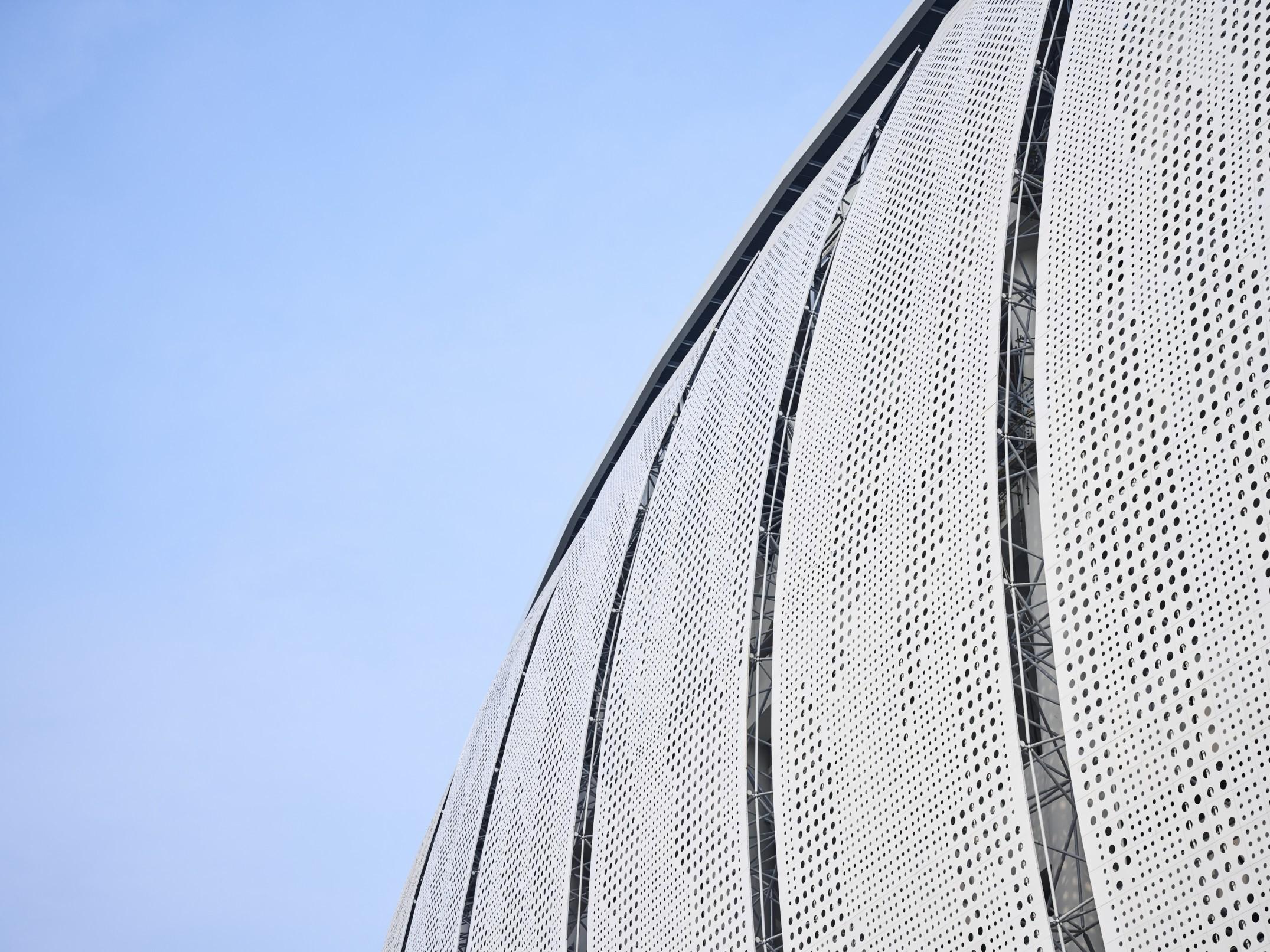
The layer of roof material that we see from a distance has an equally important role.
It must be able to:
- protect from the heat of the sun
- withstand heavy rain
- endure extreme weather changes
- maintain the visual appearance of the building
This is where materials such as COLORBOND® steel become part of the design solution.
It should be noted that COLORBOND® Steel this year has reached the age of 60 years as a global brand of coated steel products from BlueScope, which continues to be developed to meet the needs of modern architecture.

Technology That Shapes Stadium Performance
At the scale of buildings such as stadiums, material performance becomes very crucial. COLORBOND® steel comes with various technologies that work in layers:
- Thermatech® Solar Reflectance Technology
Helps reflect solar heat, keeping the temperature under the roof more comfortable. - Aluminium-Zinc Coating (AZ150–AZ200)
Provides protection against corrosion in challenging environmental conditions. - Super Polyester Paint System
Maintains color stability, ensuring a consistent appearance over the long term. - Clean Technology
Helps keep the surface clean for longer, which is important for large-scale buildings such as stadiums.
Material Options for Large-Scale Needs
Each project has different needs. Therefore, material flexibility becomes important.
COLORBOND® steel is available in several variants:
- COLORBOND® Steel Ultra
Substrate: ZINCALUME® steel AZ200 (Zn/Al Alloy-Coated Steel)
For environments with high corrosion levels. - COLORBOND® Steel XAL
Substrate: Aluminium Alloy 3105 H16
Provides a lightweight and adaptive character. - COLORBOND® Steel XPD
Substrate: ZINCALUME® steel AZ150 (Zn/Al Alloy-Coated Steel)
Balanced protection for various building applications. - COLORBOND® Steel XRW
Substrate: ZINCALUME® steel AZ150 (Zn/Al Alloy-Coated Steel)
Designed to help maintain surface cleanliness for longer. - COLORBOND® Steel Matte Finish
Substrate: ZINCALUME® steel AZ150 (Zn/Al Alloy-Coated Steel)
With low gloss (±7 G.U), reducing glare and presenting a calmer appearance.
Durability for Buildings Used by Thousands of People
A stadium is not an ordinary building. It is used by thousands of people at the same time.
Therefore, the materials used must be able to last in the long term.
COLORBOND® steel offers:
- Corrosion resistance warranty up to 35 years
- Color durability warranty up to 12 years*
*Terms and conditions apply
This provides assurance that material performance remains maintained, even under intensive use.
When Structure Becomes Identity
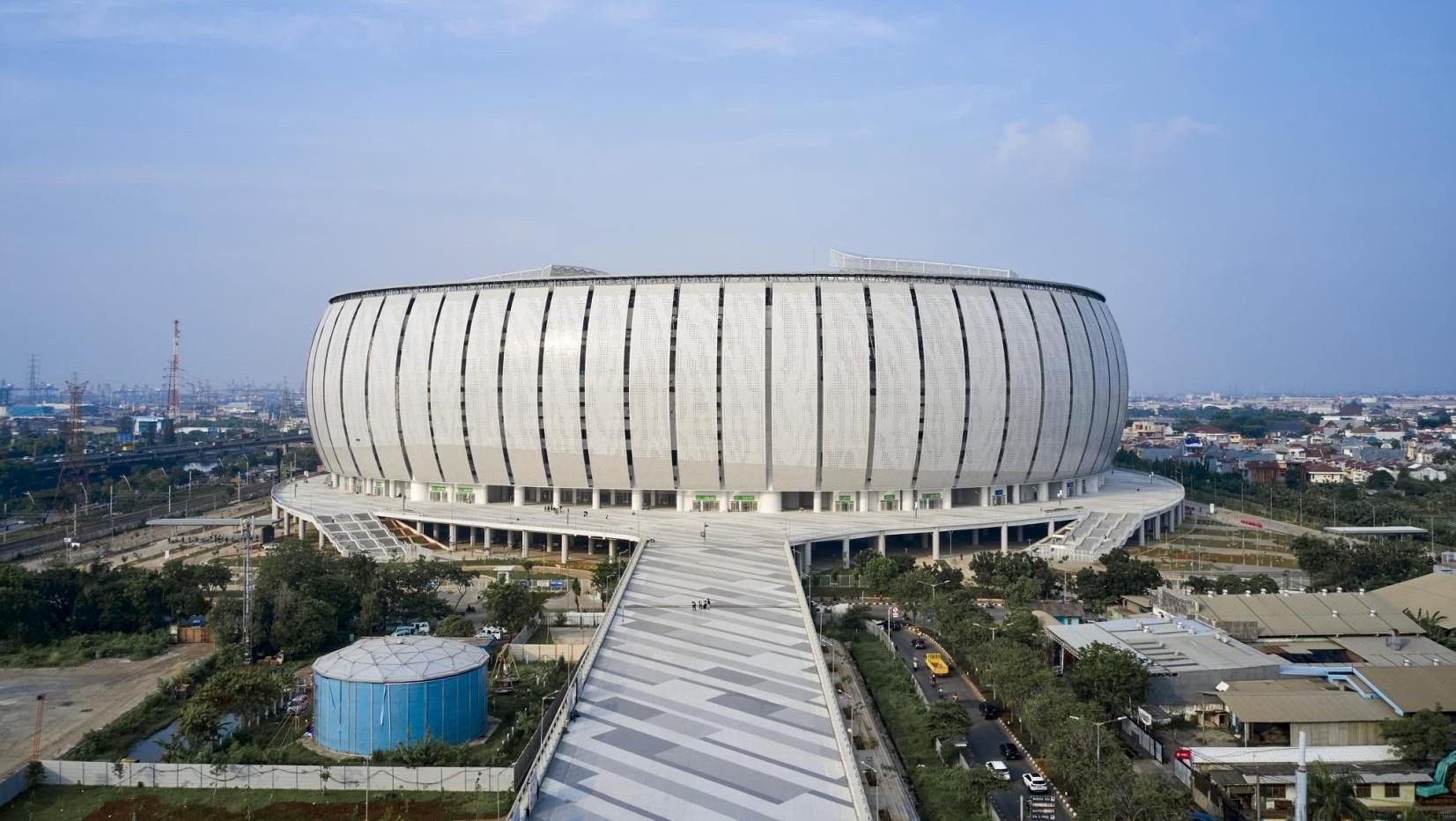
Looking at Jakarta International Stadium, we do not only see a sports building. We see how structure shapes experience. The wide-span roof is not just a technical solution. It becomes part of the stadium’s identity itself. The steel structure works silently, supporting, protecting, and shaping space without needing to appear dominant.
Iconic, Because It Does Not Feel Forced
In architecture, something often feels iconic not because it is made different, but because it is made right. In this stadium, every element has its role. Structure provides strength. material provides protection, and design unites everything into one spatial experience. And perhaps, that is where the beauty lies when complexity is hidden within simplicity that feels natural.
FAQ
- What is meant by wide-span stadium design?
Wide-span stadium design is an architectural approach that allows the roof to span widely without many supporting columns in the middle. The goal is to keep the spectators’ view unobstructed and to create an optimal visual experience from every seating position. - Why do modern stadiums avoid using many columns?
Modern stadiums are designed to provide maximum visibility to the field. The presence of columns in the middle of the stands can disrupt spectators’ views, so structures are designed to support the roof without many vertical elements in the main area. - How does steel structure enable column-free stadiums?
Steel structures have high strength and design flexibility that allow long spans without additional supports. With precise calculations, steel can support stadium roofs on a large scale without compromising stability. - What are the advantages of metal stadium roofs such as COLORBOND® steel?
Metal roofs such as COLORBOND® steel have several advantages, such as corrosion resistance, color stability, and the ability to reflect heat. This material is also relatively lightweight, supporting wide-span designs in modern stadiums. - Why is roof material important in stadium design?
Roof material plays a role in protecting spectators from heat and rain, maintaining spatial comfort, and ensuring long-term building durability. In large-scale stadiums, material selection also affects maintenance efficiency. - Do modern stadiums require low-maintenance materials?
Yes. Stadiums are used by many people and have very large areas, so low-maintenance materials are very important. Materials such as COLORBOND® steel are designed to maintain performance and appearance without requiring intensive maintenance.